Market Pulse
The Bank of Canada cut rates by 50bps during October in an attempt to spur growth by easing the pressure on Canadian consumers. Although a 50bps cut is not insignificant, the move was expected and resulted in little market movement upon the news. The BoC's attempt to stimulate growth came just before the announcement that Q3 annualized GDP growth was 1.0% which fell well below the expected growth rate of 1.5%. Elevated borrowing costs have put a strain on business investments, output, & consumer demand.
The United States economic trend of disinflation remains the same. The Federal Reserve's preferred measure of inflation, core PCE, met expectations of 0.3% month-over-month, and 2.7% year-over-year. In the Personal Income and Outlays report, US consumers showed solid consumption growth, although this was supported by declining savings rates. The Employment Cost Index which measures the cost of labour to businesses rose 0.8% in Q3, which was mild deceleration from the previous quarter. Other growth metrics showed relative strength as quarterly annualized GDP growth came in at 2.8%. The GDP report, which uses percentage contribution to GDP growth, was strong across the board in every category except for housing. These indicators support a possibility of a no-landing scenario, rather than a soft-landing which many believe is currently being priced into the market.
While global growth is expected to remain stable, it is not expected to be robust, as an upwards revised US economic projection is being offset by a downgraded outlook for other developed economies such as the larger European countries. In a similar sense, markets in the middle east have experienced downward revisions due to political unrest and difficulties with the production and shipping of oil. This is offset by strong growth in Asian emerging markets which are getting a boost from surging demand for semiconductors and electronics driven by investments in artificial intelligence. Overall, global growth should hit 3.1% five years from now.
As investors continue to see elevated valuations, the discussion around their impact on future returns has become more common. While valuations are not a cyclical or tactical tool for timing the market, they can be predictive of future returns. When using valuations as a way of projecting future returns, some analysts are anticipating non-US developed markets to outperform US markets by about 2%, as US markets have benefited the most from recent market growth, and therefore have the most inflated valuations. For context, the S&P500 has nearly doubled ex-US global index funds over the past year, leading analysts to believe a reversion could be coming.
Similar to the price of gold, silver has shone this year, following a multi-decade trend of poor performance. The run on silver indicates an interesting contrast where continued strength could suggest resilience in the global economy due to silver's heavy usage in industrial processes, while at the same time many other commodities are experiencing a downtrend. To summarize, a persistent rally in silver signals underlying economic strength even as other commodities face headwinds. Silver rose 4% in October and 37% YTD.
China's recent stimulus measures are falling well short of what emerging market strategists deem necessary to reflate the economy. News agencies have reported that China plans to do $10T in bond issuance over the next three years. The plan is for $6T to go to improving the balance sheets of local governments, and the remaining $4T to go to buying idle land and housing. While these measures will marginally enhance financial stability, it will not have a material impact on macroeconomic reflation. Currently, local governmental debt totals $70T so the $6T in stimulus directed to it, while necessary, will not aid the economy quickly. China's economy will likely remain depressed if they do not shift their focus to stimulating individual households, lifting property prices, and boosting private business confidence.
All data sourced from FACTSET and Bloomberg L.P.
All data is for the reported month and in local currency.
The Ups & Downs
- JP Morgan & Chase Co (JPM) failed to disappoint, gaining another 8.61% in October after beating estimates in their third quarter. Long-term net inflows were a record 72 billion for the company.
- Shares of Dollarama (DOL) climbed another 7.14% in the month. The company's strategic expansion into South America through its 60.1% stake in Dollar City has largely been a success. The company has announced further plans to expand the chain into Mexico.
- Shares of Granite Real Estate Investment Trust (GRT.UN) pulled back 8.54% in October. Gains made in September were wiped out, the stock continues to remain range bound throughout the year.
- Nucor Corporation (NUE) declined 6.28% in the month after reporting a dismal quarter. Concerns around future steel demand and infrastructure spending in a slowing economy, coupled with the threat of Chinese over-supply are weighing on the company.
All data sourced from FACTSET and SIACharts.
All data is for the reported month and in local currency.
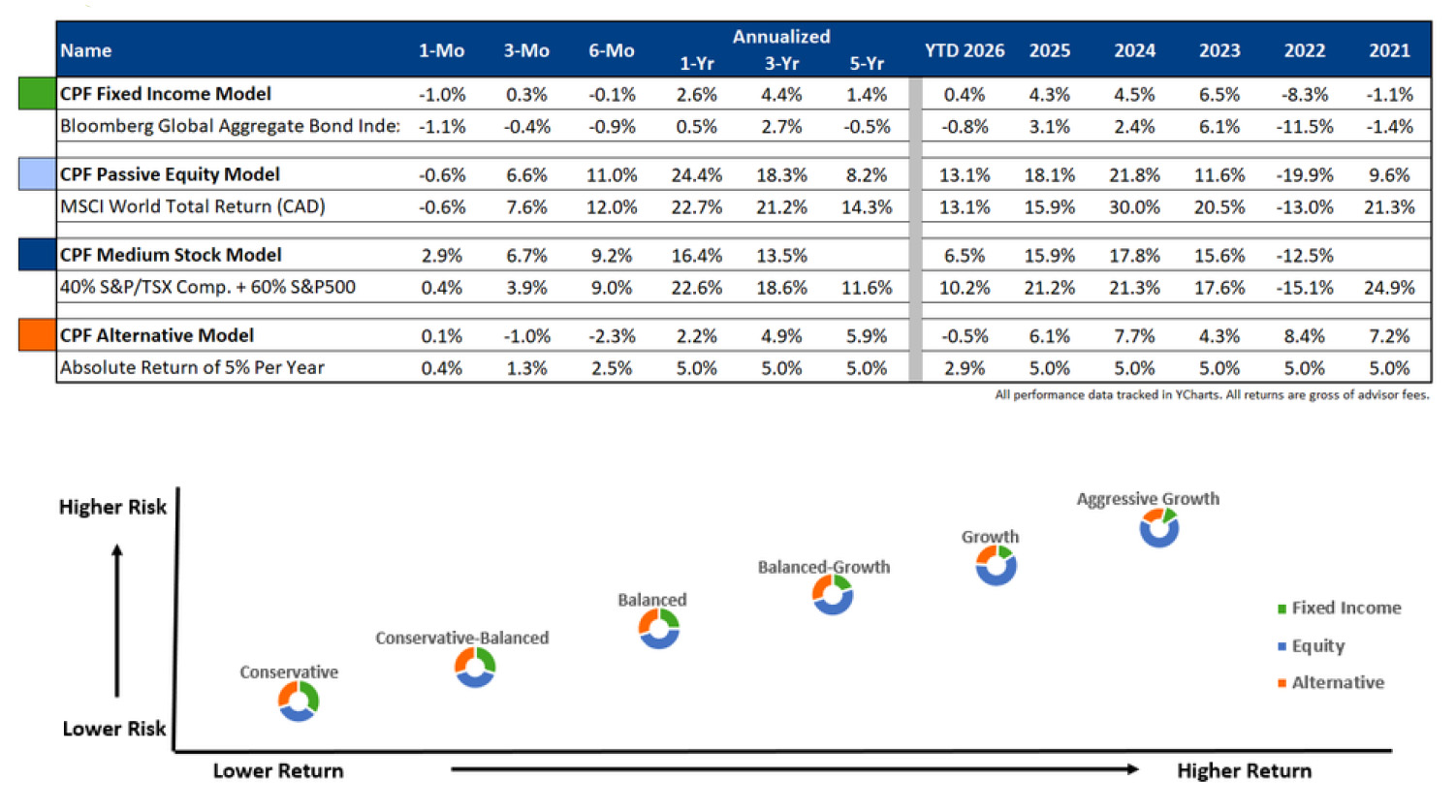
Portfolio Returns
As of October 31st, 2024

Portfolio Highlights
Microsoft (MSFT.TO) surged 24.20% after a blowout fiscal Q4. Revenue of $90.0 billion (up ~18%) and non-GAAP EPS of $4.74 both cleared estimates, driven by the Intelligent Cloud segment as Azure grew 43% and crossed $100 billion in annual revenue for the first time. The result reasserted Microsoft's cloud leadership and eased fears that AI infrastructure costs would erode margins—though it's worth noting the beat was aided by a $3.2 billion gain on its Anthropic stake.
Canadian Natural Resources (CNQ.TO) advanced 19.00%, buoyed by firmer crude prices amid Middle East supply risks and improving sentiment across Canadian energy. The stock drew multiple analyst upgrades, including Zacks lifting it to Strong Buy, while constructive pipeline developments—British Columbia softening its opposition to new pipelines and an Alberta-Ontario proposal for a transcontinental line—added tailwinds. The move reinforced CNQ's standing as a low-cost, capital-disciplined free-cash-flow generator.
TELUS (T.TO) declined 10.80% after a weak Q2 that paired an earnings and revenue miss with a sweeping strategic reset. A C$2.1 billion non-cash impairment at TELUS Digital drove a C$1.8 billion net loss, and the company cut its dividend by 55% while lowering full-year revenue and EBITDA guidance, redirecting capital toward deleveraging. The reset triggered downgrades from Morgan Stanley, CIBC, and Barclays, underscoring the structural and competitive pressures—including Starlink—facing Canadian telecom.
CRH (CRH) fell 8.31% despite a Q2 earnings beat. EPS of $2.21 topped the $2.02 consensus, but full-year 2026 EPS guidance of $5.60–$6.05 landed with a midpoint below the ~$5.95 consensus, and subdued residential construction activity amid high mortgage rates remained a headwind. The pullback reflects investor caution on near-term demand even as infrastructure spending and pricing stay supportive.
All data sourced from FACTSET and Bloomberg L.P.
All data is for the reported month and in local currency.
Macro Watch
In July 2026, the International Monetary Fund released its updated World Economic Outlook, projecting global growth to hold at 3.0% for the year while confirming that global disinflation has essentially stalled. The macroeconomic landscape is becoming increasingly fractured, creating a sharp divide between nations integrated into the booming technology supply chain and those vulnerable to commodity shocks. Policymakers are now navigating an environment where AI-driven demand lifts certain economies, even as prolonged geopolitical conflicts weigh heavily on energy importers.
Energy supply chains remained a volatile focal point throughout the month, significantly altering global inflation trajectories. While a mid-June memorandum of understanding between the U.S. and Iran briefly allowed for the reopening of the Strait of Hormuz, renewed hostilities in July disrupted the gradual recovery of global oil markets. This instability generated a severe supply shock for oil, gas, and fertilizers, ultimately forcing upward revisions in core inflation forecasts and keeping financial markets on high alert.
Despite elevated borrowing costs and global commodity disruptions, the U.S. economy continues to display remarkable resilience compared to its European counterparts. Domestic growth remains steady, heavily supported by massive capital expenditures in artificial intelligence that provide a strong structural floor for business activity. Furthermore, because the U.S. operates as a net energy exporter, its robust consumer sentiment has been largely shielded from the energy price spikes currently suppressing growth in the U.K. and the Eurozone.
All data sourced from FACTSET and SIACharts.
All data is for the reported month and in local currency.
Portfolio Returns
July 2026