Market Pulse
In April, the Canadian economy added 90,400 jobs, exceeding expectations of a 20,000 job increase. This growth, driven entirely by the services sector with 100,700 new jobs, left the unemployment rate unchanged at 6.1% despite a 10,400 job decline in the goods sector. High immigration since 2022 has raised the baseline for necessary employment growth, meaning substantial job increases are needed to maintain the current unemployment rate. This erratic labor market is unlikely to deter the Bank of Canada from reducing interest rates, potentially in June, as employment growth linked to population increases doesn't inherently drive inflation.
China plans to have local governments buy unsold homes from distressed developers, converting many into affordable housing. This proposal involves state-owned enterprises purchasing homes at steep discounts using state bank loans, and could require up to 2 trillion yuan (CA$377 billion). The move follows pilot programs and recent measures by cities to stimulate housing demand and could ultimately increase local government debt and strain banks already facing bad loans and narrowing margins.
The International Energy Agency (IEA) lowered its global oil demand growth forecast by 140,000 barrels a day to 1.1 million barrels a day due to economic slowdowns and mild weather in Europe. Despite this, annual consumption is expected to reach a record 103.2 million barrels a day. The IEA’s projections are more conservative compared to industry estimates which are forecasting higher growth.
India’s Prime Minister Narendra Modi has focused on infrastructure investments to boost economic growth and connectivity. Despite challenges like high logistics costs and financing hurdles, Modi's government has committed 11.11 trillion rupees (CA$182 billion) for new projects, including a new highway between New Delhi and Mumbai and India’s first bullet train, aiming to support long-term growth and job creation.
The aging population in North America is expected to drive up wages and inflation, necessitating higher interest rates. This demographic shift is prompting pension funds and asset managers to adjust their strategies, favoring equities and inflation-resistant assets over traditional bonds. Global variations in aging rates make regions like India and Indonesia more favorable due to their growing working-age populations.
On May 2, 2022, a Citigroup Inc. trader in London mistakenly entered a $444 billion (CA$606 billion) trade instead of $58 million (CA$79 million), causing a massive sell-off across European exchanges. This five-minute flash crash wiped €300 billion (CA$444 billion) off European stocks. UK regulators fined Citigroup for risk management failures, noting the bank's systems generated 711 warnings, many of which were overridden. The error was caught 15 minutes later, resulting in a multi-million dollar loss for the bank.
All data sourced from FACTSET and SIACharts.
All data is for the reported month and in local currentestcy.
The Ups & Downs
- Shares of Apple Inc. (AAPL) rebounded 12.45% in May. Investors expect upcoming AI-enabled products will boost revenue growth for the tech giant.
- Manulife Financial (MFC) continued to outperform the industry climbing another 10.50%. Recent success is largely due to their rapidly expanding insurance business in Asian markets. MFC has beaten earnings in each of their last six quarterly reports.
- Deere & Co. (DE) shares dropped 5.89% despite beating analyst expectations for the quarter. The company spooked investors by reducing annual earnings guidance in their latest report.
- Abbott Laboratories (ABT) lost 3.99% in May. Challenges from reduced demand for COVID-19 testing and increased operating expenses are hindering growth.
All data sourced from FACTSET and SIACharts. All data is for the reported month and in local currency.
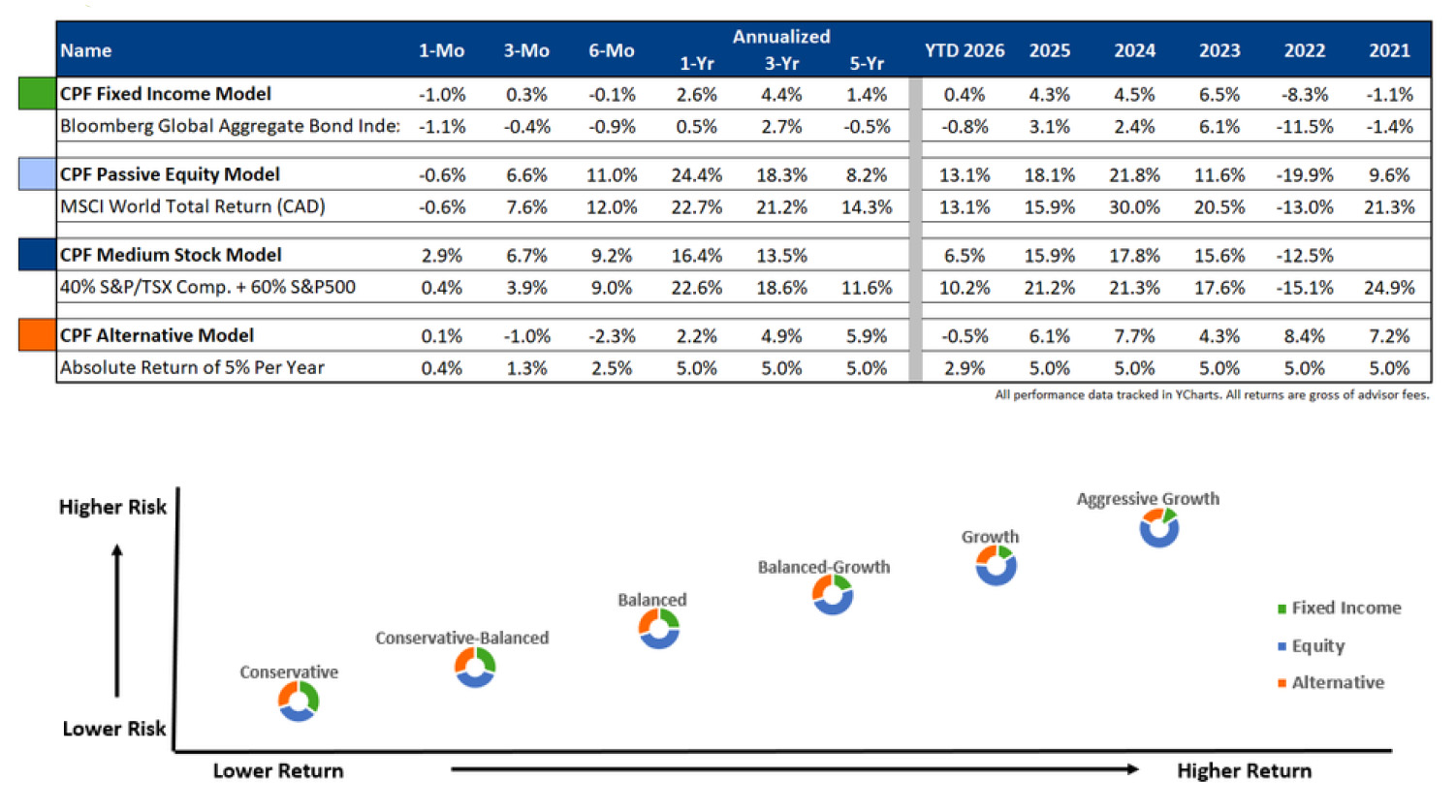
Portfolio Returns
As of May 31st, 2024

Portfolio Highlights
Microsoft (MSFT.TO) surged 24.20% after a blowout fiscal Q4. Revenue of $90.0 billion (up ~18%) and non-GAAP EPS of $4.74 both cleared estimates, driven by the Intelligent Cloud segment as Azure grew 43% and crossed $100 billion in annual revenue for the first time. The result reasserted Microsoft's cloud leadership and eased fears that AI infrastructure costs would erode margins—though it's worth noting the beat was aided by a $3.2 billion gain on its Anthropic stake.
Canadian Natural Resources (CNQ.TO) advanced 19.00%, buoyed by firmer crude prices amid Middle East supply risks and improving sentiment across Canadian energy. The stock drew multiple analyst upgrades, including Zacks lifting it to Strong Buy, while constructive pipeline developments—British Columbia softening its opposition to new pipelines and an Alberta-Ontario proposal for a transcontinental line—added tailwinds. The move reinforced CNQ's standing as a low-cost, capital-disciplined free-cash-flow generator.
TELUS (T.TO) declined 10.80% after a weak Q2 that paired an earnings and revenue miss with a sweeping strategic reset. A C$2.1 billion non-cash impairment at TELUS Digital drove a C$1.8 billion net loss, and the company cut its dividend by 55% while lowering full-year revenue and EBITDA guidance, redirecting capital toward deleveraging. The reset triggered downgrades from Morgan Stanley, CIBC, and Barclays, underscoring the structural and competitive pressures—including Starlink—facing Canadian telecom.
CRH (CRH) fell 8.31% despite a Q2 earnings beat. EPS of $2.21 topped the $2.02 consensus, but full-year 2026 EPS guidance of $5.60–$6.05 landed with a midpoint below the ~$5.95 consensus, and subdued residential construction activity amid high mortgage rates remained a headwind. The pullback reflects investor caution on near-term demand even as infrastructure spending and pricing stay supportive.
All data sourced from FACTSET and Bloomberg L.P.
All data is for the reported month and in local currency.
Macro Watch
In July 2026, the International Monetary Fund released its updated World Economic Outlook, projecting global growth to hold at 3.0% for the year while confirming that global disinflation has essentially stalled. The macroeconomic landscape is becoming increasingly fractured, creating a sharp divide between nations integrated into the booming technology supply chain and those vulnerable to commodity shocks. Policymakers are now navigating an environment where AI-driven demand lifts certain economies, even as prolonged geopolitical conflicts weigh heavily on energy importers.
Energy supply chains remained a volatile focal point throughout the month, significantly altering global inflation trajectories. While a mid-June memorandum of understanding between the U.S. and Iran briefly allowed for the reopening of the Strait of Hormuz, renewed hostilities in July disrupted the gradual recovery of global oil markets. This instability generated a severe supply shock for oil, gas, and fertilizers, ultimately forcing upward revisions in core inflation forecasts and keeping financial markets on high alert.
Despite elevated borrowing costs and global commodity disruptions, the U.S. economy continues to display remarkable resilience compared to its European counterparts. Domestic growth remains steady, heavily supported by massive capital expenditures in artificial intelligence that provide a strong structural floor for business activity. Furthermore, because the U.S. operates as a net energy exporter, its robust consumer sentiment has been largely shielded from the energy price spikes currently suppressing growth in the U.K. and the Eurozone.
All data sourced from FACTSET and SIACharts.
All data is for the reported month and in local currency.
Portfolio Returns
July 2026